
- Welt:
- Arabistik und Islamwissenschaften
- Name der Veranstaltung:
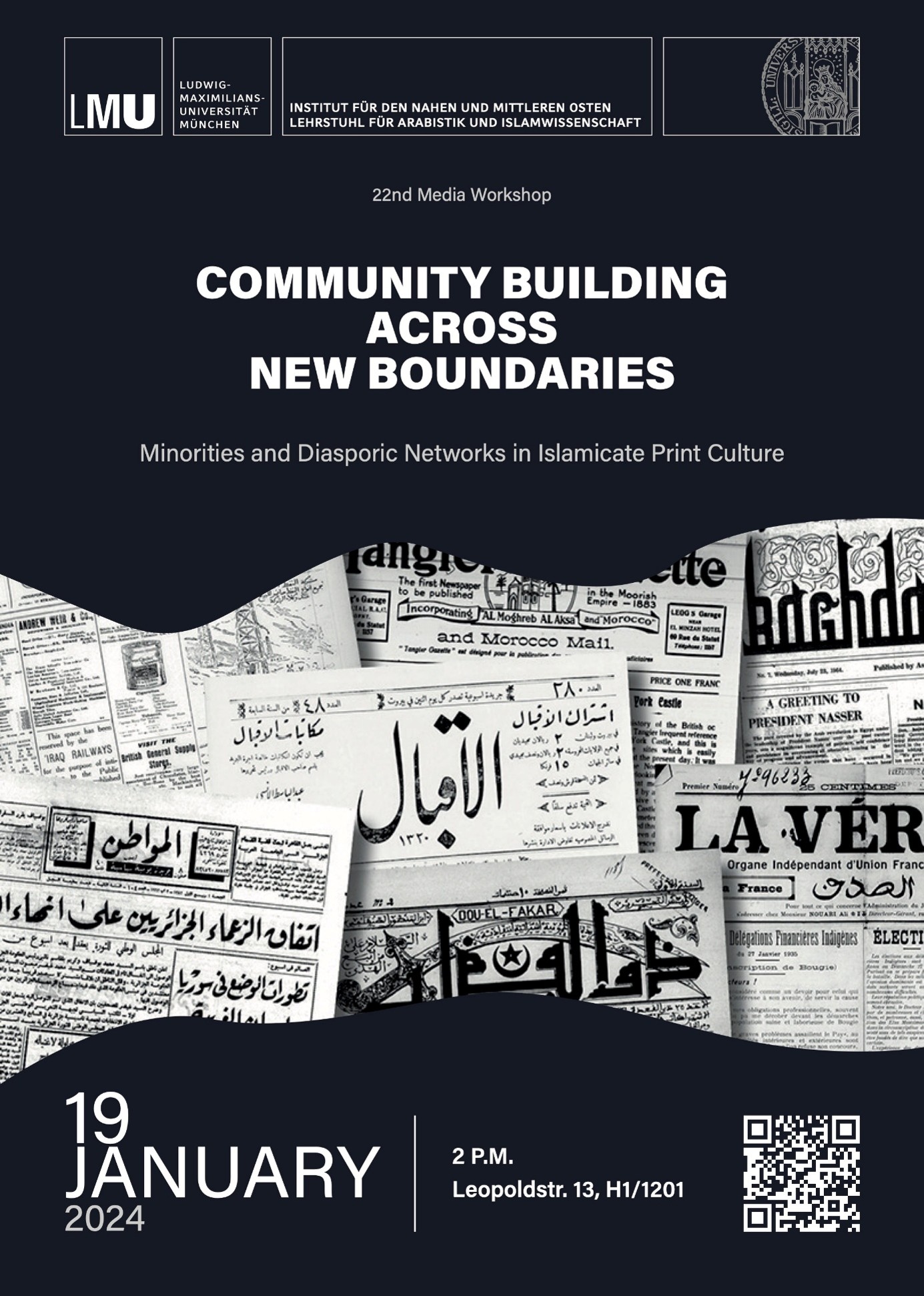
- Medienworkshop: Community Building across New Boundaries - Minorities and Diasporic Networks in Islamicate Print Culture
- Datum der Veranstaltung:
- 19.01.2024
- Ort:
- Leopoldstr. 13, H1 / 1201
- Thema:
- Community Building across New Boundaries
- Veranstalter
- research group „Arabic Mass Media and (trans)regional digital cultures
Programm:
- 2.00 p.m.
- Welcome at the venue: LMU Munich, Leopoldstr. 13, H1 / 1201
- 2.15 p.m.
- Introduction, by Björn Bentlage: Of Nations, Bubbles, and Communities: the Imaginative Powers of (trans)Regional Mass Media
- 3.00 p.m.
- Break
- 3.30 p.m.
- Keynote, by Yvonne Albers: United in Print? Reconsidering 'Community' through Arab Periodical Studies
- 5.00 p.m.
- Break
- 5.30 - 6.30 p.m.
- Two case studies
Yezidi Periodicals (since the 1990s), by Qader Shammo The Commendatory Republic: Multi-Modal Taqrīẓ in the Periodical al-Maʿrifa (1931-34), by Mariam Elashmawy - 7.30 p.m.
- Dinner (invited guests only)
For all speakers and prospective contributors to the planned special issue, the workshop will continue on the following day (Saturday, January 20, 2024) with an internal discussion focused on the publication project.
The research group Arabic Mass Media and (trans)regional digital cultures at Munich University organizes a workshop titled “Community Building across New Boundaries: Minorities and Diasporic Networks in Islamicate Print Culture”, with a public session on Friday, 19 January 2024.
The workshop builds on recent research that highlights the importance of serialized print media—such as journals and periodicals—especially in the late 19th and 20th centuries, when these formats functioned as key media of communication. While earlier studies have shown how print media contributed to nationalism and social cohesion, this workshop shifts the focus to less-studied contexts.
It explores how print media were used at the margins of the Islamic Middle East, including by minority communities, diaspora networks, and regions far from established cultural centers. Particular attention is paid to the rhythms of serial publication and its role in fostering communal ties across political and symbolic boundaries during the “Age of Steam and Print.”
© LMU