ArchaeoTin: “Archaeology in World Heritage – Tin Mining Landscapes” (Interreg)
ArchaeoTin: “Archaeology in World Heritage – Tin Mining Landscapes” Research on tin mining in the Ore Mountains carried out in German–Czech cooperation

ArchaeoTin: “Archaeology in World Heritage – Tin Mining Landscapes” Research on tin mining in the Ore Mountains carried out in German–Czech cooperation

© Ken Massy
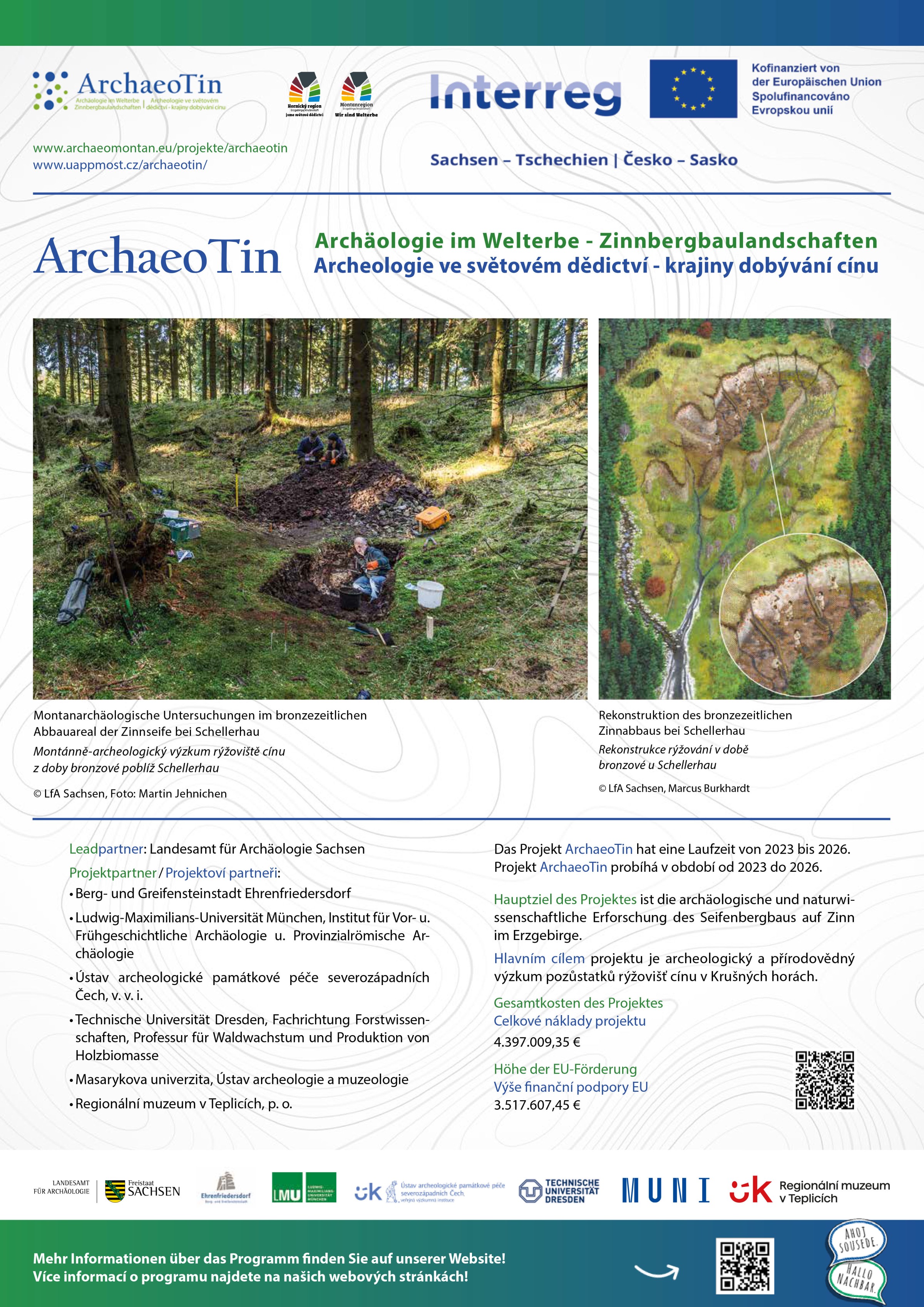
The project involves cross-border interdisciplinary research into tin mining with a focus on placer mining in the Ore Mountains, as well as the processing and presentation of the findings. Against the backdrop of evidence discovered in the ArchaeoMontan projects for the extraction of tin in the Ore Mountains as early as the Bronze Age, the extraction, processing, distribution, and social and ecological impacts in the European context are to be examined diachronically. Archaeological, historical, and scientific investigations are just as much in the foreground as the public dissemination of the results obtained in the World Heritage Site. The State Office for Archaeology in Saxony, together with six partner institutions from Czechia, Bavaria (LMU Munich, Institute for Pre- and Early History Archaeology and Provincial Roman Archaeology) and Saxony, will systematically research tin mining from the beginning of the Bronze Age to modern times in the "ArchaeoTin" project. The scientists at LMU (Prof. Dr. Carola Metzner-Nebelsick, Dr. Ken Massy, PD Dr. Michael Peters, and Thilo Kappelmeyer M.Sc.) are responsible for evaluating prehistoric and paleoecological archives in a local to pan-European context.

© Ken Massy
The first projects have been launched under the Interreg Saxony–Czechia 2021–2027 program. At its meeting on June 29, 2023, in Kostelec nad Ohří (Czech Republic), the program's monitoring committee approved 13 cross-border cooperation projects. They will receive a total of €25.3 million in funding from the European Union.
"I am delighted that the projects in the Saxon-Czech border regions can now get underway, thereby continuing and consolidating the long-standing cooperation between many stakeholders," said Minister of State Thomas Schmidt. "For the 'Interreg Saxony-Czechia 2021-2027' program, which is led by the Free State of Saxony, around 142.3 million euros from the ERDF are available for the concrete support of cross-border projects," the minister continued.
Among the confirmed projects are three initiatives for the preservation and maintenance of cultural heritage. For example, the State Office for Archaeology in Saxony will systematically research tin mining in the "ArchaeoTin" project together with six partner institutions from Czechia, Bavaria, and Saxony. The project will highlight the European significance of Erzgebirge tin from the Bronze Age to modern times and present the findings in a multimedia traveling exhibition. Since 2019, 22 sub-areas of the Ore Mountains have been inscribed as a UNESCO World Heritage Site. The strategic project makes an important contribution to the preservation of the Saxon-Czech mining region and is funded with 3.5 million euros.
