Pre- and Protohistoric Archaeology and Provincial Roman Archaeology
Ilmendorf Training Excavation – Early Bronze Age Settlement and Middle Bronze Age Barrow Cemetery
Investigations of an Early Bronze Age settlement and a Middle Bronze Age barrow cemetery near Ilmendorf, municipality of Geisenfeld, district of Pfaffenhofen an der Ilm – campaigns 2011–2015
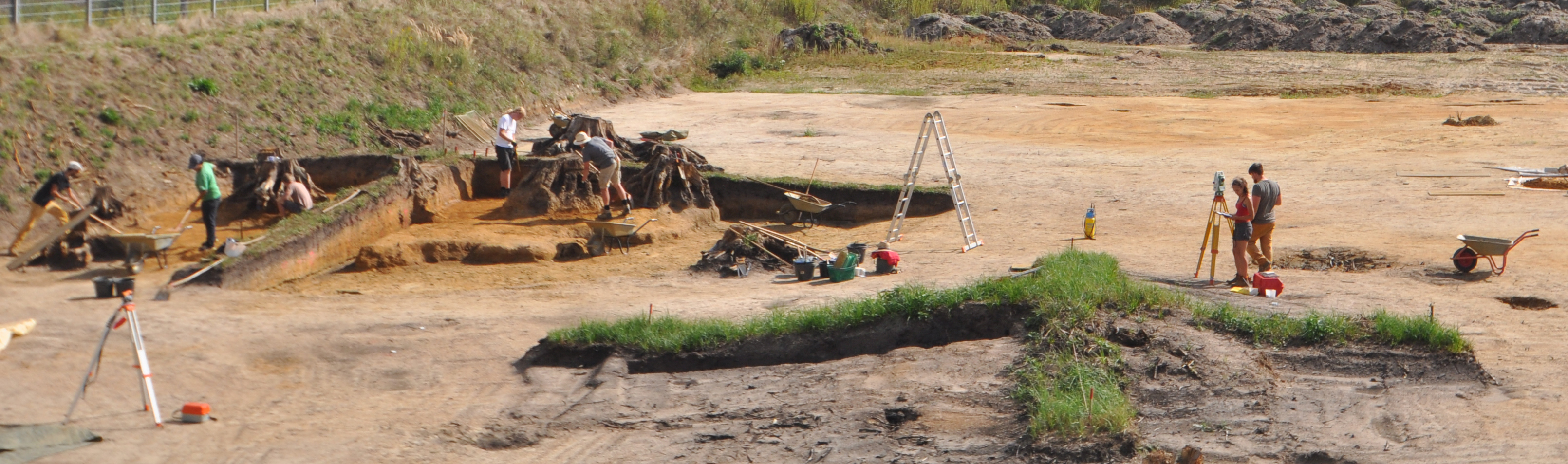
As part of the planned expansion of a company site near Ilmendorf, groundwork was carried out in the area of a Middle Bronze Age burial mound field that had been known for some time. Eleven mounds, which were originally located in a small wooded area, and an extensive area to the southwest had already been archaeologically investigated in 2008/2009. On August 1, 2011, the Institute for Prehistoric and Early History Archaeology and Provincial Roman Archaeology at Ludwig Maximilian University in Munich began excavating and documenting the endangered findings as part of an eight-week teaching excavation for the bachelor's degree program "Archaeology of Europe and the Near East." The excavation team, which was supported by the BLfD and the Munich State Archaeological Collection, included several specialists, so that in addition to excavation techniques, students were also taught the basics of surveying, artifact recovery, excavation-accompanying conservation, restoration, and soil science.
For the first campaign in 2011, an area of approximately 2000 m² with a hill visible above ground on the southern edge of the grave group was selected. Area 1, in the vicinity of the Early Bronze Age settlement, yielded almost 100 larger and smaller pit finds, some of which contained rich ceramic material and can be attributed to the Arbon-Landsberg cultural group. The finds from Ilmendorf are thus the second evidence of such western cultural contacts in the greater Ingolstadt area in the late Early Bronze Age (FB III). Although post holes indicate prehistoric construction on the site, it is not yet possible to reconstruct Early Bronze Age large-scale buildings, such as those found in the area to the west during earlier excavations.
The Middle Bronze Age burial mound investigated in 2011 originally measured approx. 17 m in diameter and was only recognizable in profile as a 15–20 cm high, largely eroded elevation. Underneath the mound, a slight depression in the underlying sandy soil with a diameter of 15 m and a depth of 10–20 cm was documented, with pits dug around its outer periphery. Although no traces of a burial had been preserved in situ, valuable observations about the structure of the mound were made.
A surprising discovery was a pit house with six posts located east of the hill, which could be attributed to the late Hallstatt or early Latène period based on a few ceramic finds.
The restoration of the finds and the excavation of block recoveries by the Munich State Archaeological Collection, as well as the evaluation of the findings and discoveries from the 2011-2015 excavation campaigns by LMU Munich, are currently underway.
Publications:
C. Metzner-Nebelsick/S. Hanöffner/H. Schwarzberg/W.-R. Teegen, Früh- und mittelbronzezeitliche Siedlungs- und Grabfunde von Ilmendorf, Gemeinde Geisenfeld, Landkreis Pfaffenhofen a. d. Ilm, Oberbayern. Arch. Jahr Bayern 2011 (Stuttgart 2012) 90-91.
C. Metzner-Nebelsick/W.-R. Teegen/A. O’Neill/C. von Nicolai/F. Stremke, La nécropole tumulaire du Bronze moyen à Geisenfeld-Ilmendorf (Ingolstadt, Bavière, Allemagne). In: T. Lachenal, C. Mordant, T. Nicolas/C. Véber (Hrsg.), Bronze 2014. Le Bronze moyen et l’origine du Bronze final en Europe occidentale, de la Méditerranée aux pays nordiques. Actes du Colloque International du 17 au 20 juin 2014 à Strasbourg (Dijon 2017) 753-761.
Further Publications:
M. Bankus/K.-H. Rieder, Westliche und östliche Einflüsse im Ingolstädter Becken während der frühen und mittleren Bronzezeit. In: B. Eberschweiler/J. Köninger/H. Schlichtherle/C. Strahm (Hrsg.), Aktuelles zur Frühbronzezeit und frühen Mittelbronzezeit im nördlichen Alpenvorland. Rundgespräche Hemmenhofen, 6. Mai 2000. Edward Sangmeister gewidmet zum 85. Geburtstag. Hemmenhofener Skripte 2 (Gaienhofen-Hemmenhofen 2001) 47–66;
St. Möslein, Die Straubinger Gruppe – Zur Frühbronzezeit in Südostbayern; Ebd. 17–30; P. Honig, Studien zur bronzezeitlichen Keramikentwicklung am Beispiel der Siedlungskeramik der Windsheimer Bucht und des süddeutschen Donauraumes. Arbeiten Arch. Süddeutschland 22 (Büchenbach 2008); R. Gläser/S. Conrad, Auf Sand gebaut - Bronzezeitliche Grabhügel und Siedlungsbefunde bei Ilmendorf. Arch. Jahr Bayern 2009 (Stuttgart 2010) 41–43.