
Archaeological research in the center of the ancient city

North profile area 3, 2020 campaign
© Salvatore Ortisi
A research collaboration between the city of Kempten and Ludwig Maximilian University in Munich, which has been in place since 2019, offers a unique opportunity to conduct archaeological investigations in the center of the ancient city of Cambodunum/Kempten. The oldest Roman city in the province of Raetia is considered a prime example of early imperial urban planning.
The layout of the Roman city has been known since the excavations carried out by the Kempten Local History Association in the late 19th and early 20th centuries. In keeping with the possibilities of the time, the focus was primarily on following the walls. The oldest settlement layers, located at a lower level, have rarely been recorded.
The research project focuses on the last ancient city quarter that has not yet been built on, the so-called Insula 1, located directly opposite the Forum. In the 2019 and 2021 campaigns, investigations concentrated on the southwestern corner of the Insula. In addition to clarifying the construction sequence of the stone buildings, which are already known in broad terms, the focus was particularly on the older settlement structures located underneath.

Island 1
© Salvatore Ortisi
The search cuts made by the excavators were clearly visible and were mostly limited to a narrow, not too deep strip along the walls. The older layers were therefore found largely undisturbed. Two test pits dug down to the natural ground revealed a complex stratigraphy, showing that the (stone) construction of Insula 1 was preceded by several phases of settlement and use. In addition to massive fillings, which indicate extensive leveling of the site prior to construction, screed and wooden floors belonging to the oldest findings, as well as possible workshop findings, provide evidence of the "pre-insula" construction and use of the area at the beginning of the 1st century AD.

bullet tip
© Salvatore Ortisi
Since the excavations of the 19th century, an extension to Insula 1, partially supplemented on the plans, has been discussed as the predecessor of the Flavian Forum. This extension, attributed to the so-called "Older Forum," was also investigated in the 2019–2021 campaigns. It is a large hall structure adjoining the southern portico of Insula 1 and was equipped with a monumental staircase. Judging by the findings recorded in 2020/2021, both the hall structure and the staircase were destroyed by fire in the 1st century AD and were not rebuilt afterwards. The 2021 excavation will initially conclude the work in the southwest corner of Insula I.
In 2022, the northern part of the insula was extensively excavated (see below). The aim was to examine the condition of the walls located just below the lawn and to verify the findings documented by previous excavators and clarify the sequence of phases in some unclear areas by means of test pits. The results also provide the basis for a digital 3D reconstruction. The excavation area covered almost the entire area of two residential units (houses 6 and 7), the northern of which was equipped with its own small bathing facility in a later phase. Inside the rooms, too, the remains of wall paintings revealed some high-quality furnishings. The screed-covered floors were still partially intact, so that overall, despite the previous excavations, the area investigated is in very good condition.
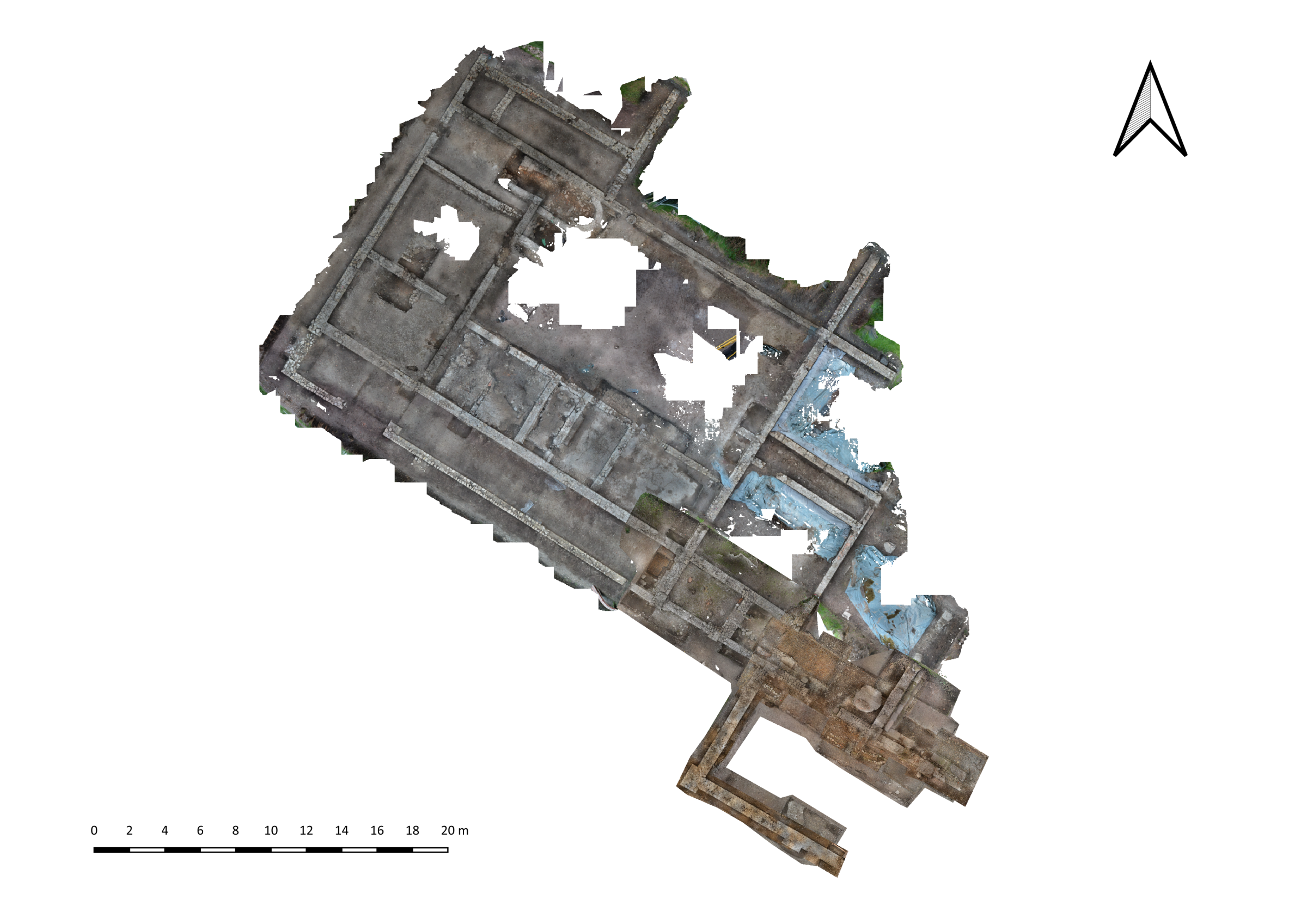
Orthographic view of the Insula 1 excavation area
© Salvatore Ortisi
Press
- Süddeutsche Zeitung 4.2.23: How archaeologists evaluate finds from ancient Kempten (SZ Plus)
- Süddeutsche Zeitung, October 27, 2022: Archaeologists discover Roman house with underfloor heating and thermal baths
- Tagesschau 10/27/22: Excavation in Bavaria: Roman house with underfloor heating
- Rundschau 10/27/22: Spectacular Roman finds in Kempten
Collaborative Partner
- Cambodunum Archaeological Park
- Kempten Cultural Office
- Bavarian State Office for the Preservation of Historical Monuments
Project Manager
Project Staff
- Dr. Sophie Hüdepohl
- M.A. Anja Reschmeier
- Julius Fagner, MA